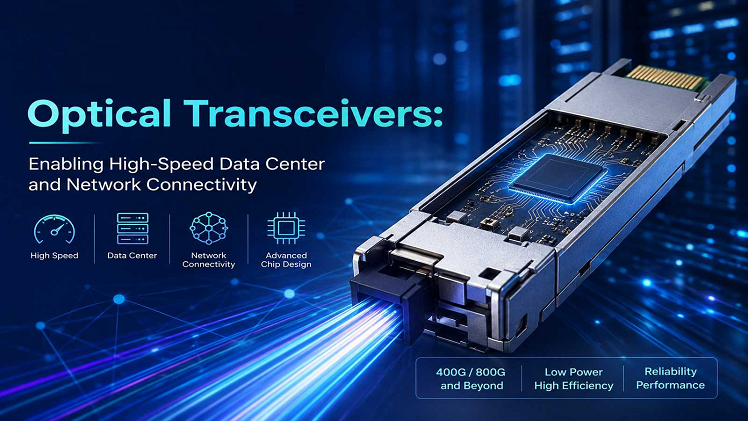
As cloud computing, artificial intelligence, video streaming, and data-intensive applications continue to expand, modern data centers require higher bandwidth, lower latency, and more efficient network infrastructure. Traditional 100G connections are no longer sufficient for many large-scale computing environments. As a result, 400G optical transceivers have become an important technology for upgrading data center, telecom, and high-performance computing networks.
A 400G optical transceiver is a compact device that converts electrical signals into optical signals and transmits data at a total rate of 400 gigabits per second. It is installed in network equipment such as switches, routers, servers, and transport platforms. Compared with lower-speed optical modules, 400G transceivers provide significantly higher bandwidth while helping network operators reduce power consumption, equipment density, and cost per transmitted bit.
How 400G Optical Modules Work
Most 400G optical modules achieve their total transmission capacity by combining multiple electrical and optical channels. For example, a module may use eight 50G electrical lanes or four 100G electrical lanes on the host side. These electrical signals are then converted into optical signals for transmission through fiber.
Modern 400G modules commonly use PAM4, or four-level pulse amplitude modulation. Unlike traditional NRZ modulation, which carries one bit per symbol, PAM4 carries two bits per symbol by using four signal levels. This allows the module to transmit more data without doubling the baud rate. However, PAM4 signals are more sensitive to noise and signal distortion, so advanced digital signal processing and forward error correction are often required.
Depending on the module type, optical transmission may use parallel fibers, wavelength division multiplexing, or a combination of both. Parallel optical modules transmit signals through multiple fiber pairs, while wavelength-multiplexed modules send several wavelengths over a single fiber pair.
Common 400G Form Factors
QSFP-DD is one of the most widely used form factors for 400G optical transceivers. The name stands for Quad Small Form Factor Pluggable Double Density. QSFP-DD provides eight electrical lanes and is backward compatible with many QSFP-based modules, including selected 40G, 100G, and 200G products. This compatibility allows network operators to upgrade their systems more gradually.
OSFP, or Octal Small Form Factor Pluggable, is another popular 400G form factor. It is slightly larger than QSFP-DD and provides strong thermal performance. OSFP modules are often used in high-density data center switches and high-performance computing systems where heat dissipation is especially important.
CFP8 is also designed for 400G applications, although it is larger than QSFP-DD and OSFP. It is more commonly found in telecom transport equipment than in modern hyperscale data center switches.
Major 400G Optical Module Types
Different 400G optical modules are designed for different transmission distances and fiber infrastructures.
The 400G SR8 module is mainly used for short-distance multimode fiber connections. It typically supports transmission distances of up to 70 meters over OM3 fiber or 100 meters over OM4 fiber. Because it uses multiple optical lanes and MPO connectors, it is suitable for connections inside data halls.
The 400G DR4 module is designed for single-mode fiber transmission over distances of up to 500 meters. It uses four 100G optical lanes and normally requires an MPO connector. DR4 modules can also support breakout applications, allowing one 400G port to connect to four separate 100G devices.
The 400G FR4 module transmits four wavelengths over a duplex single-mode fiber pair and supports distances of up to 2 kilometers. It usually uses an LC connector, making it attractive for data center interconnection and campus networks where duplex fiber infrastructure is already available.
The 400G LR4 module is designed for longer transmission distances, typically up to 10 kilometers over single-mode fiber. It is widely used in telecom, metro, enterprise, and data center interconnection networks.
For even longer distances, coherent 400G optical modules can be used. These modules employ advanced modulation, digital signal processing, and coherent detection technologies. They are suitable for metro, regional, and long-haul transmission systems.
Applications of 400G Optical Transceivers
One of the largest application areas for 400G optical modules is hyperscale data centers. Cloud service providers need extremely high-capacity connections between spine switches, leaf switches, storage systems, and computing clusters. By replacing multiple 100G links with fewer 400G links, operators can simplify network architecture and improve port efficiency.
Artificial intelligence infrastructure is another major growth area. AI training systems often contain thousands of GPUs or accelerators that must exchange large amounts of data. Network performance directly affects training efficiency, making 400G Ethernet and InfiniBand connections important for modern AI clusters.
400G modules are also used for data center interconnection. Enterprises and cloud providers frequently operate multiple data centers that must share data and computing resources. Depending on the distance, they may use 400G FR4, LR4, ZR, or coherent solutions.
Telecommunication operators use 400G technology to upgrade metro, backbone, and access networks. Higher-capacity optical links allow carriers to support increasing traffic from 5G, cloud services, streaming platforms, and enterprise applications.
Benefits and Deployment Considerations
The most obvious advantage of 400G optical transceivers is higher bandwidth. A single 400G port can replace four 100G ports, reducing the number of modules, fibers, and switch ports required. This can lower equipment costs and simplify cable management.
However, deploying 400G technology also requires careful planning. Network operators must consider transmission distance, fiber type, connector type, power consumption, heat dissipation, switch compatibility, and forward error correction requirements. The selected module must match both the host equipment and the existing fiber infrastructure.
Interoperability testing is also important, especially when modules and switches come from different manufacturers. Reliable 400G deployment depends on correct firmware coding, stable optical performance, acceptable bit error rates, and proper thermal management.
The Future of 400G Networking
Although 800G and 1.6T technologies are developing rapidly, 400G will remain an important network speed for many years. Its mature ecosystem, wide product selection, and improving cost efficiency make it suitable for both new deployments and network upgrades.
As demand for AI computing, cloud storage, and high-speed communication continues to grow, 400G optical transceivers will play a central role in modern digital infrastructure. They provide a practical balance between bandwidth, cost, power consumption, and deployment flexibility, making them a key building block for the next generation of data center and telecom networks.